
The production Recital (for Cathy) consists of two parts: the title piece Recital I (for Cathy) and a new composition by Karmit Fadael, titled The Usual. This text provides background information on both works, so you can enter the concert hall well-prepared or read up afterwards on what you’ve experienced. These program notes were written by Jacqueline Oskamp.
The Usual
The Dutch-Israeli composer Karmit Fadael (1996) presents the music-theatrical work The Usual, commissioned by Het Muziek (formerly known as Asko|Schönberg). In this piece, she engages with the current public discourse surrounding transgressive behavior, which is often focused on sexually inappropriate conduct. Fadael, however, emphasizes that such behavior can also be purely psychological in nature.
In The Usual, she places forms of microaggression under a magnifying glass. Microaggressions are subtle verbal or non-verbal expressions that may be well-intentioned, but carry an offensive or condescending subtext. For example: ‘How nice that they chose you,’ or ‘Have you been doing this long?’ According to Fadael, microaggressions are part of a normalization process—they reveal what is considered the norm, while simultaneously marking the other as someone who doesn’t fit that norm.
She herself has experienced these kinds of subtly hurtful remarks. ‘Because you tick all the boxes,’ people have said to her. Fadael: ‘Comments like that are extremely demeaning. They distract from composing, because you feel the need to prove yourself, because you’re young, because you’re a woman, or because you have a non-Dutch name.’
In The Usual, five musicians reenact these uncomfortable situations. Fadael is one of them, present on stage with her violin, although she doesn’t play it. Instead, it symbolizes the ’first violin’: a figure of authority, like a director who ‘pretends to know everything but does nothing.’ The microaggressions include touching someone, standing in front of a musician, whistling at someone, or fiddling with another’s iPad—all those small but intrusive forms of behavior.

In the meantime, three ‘lessons’ are delivered—on the definitions of normalization, microaggression, and gender—which Fadael has also translated into musical form. The lesson on normalization, for instance, is expressed through a recurring melody: first played by the saxophone, then gradually taken over by the other instruments, as the music becomes increasingly polyphonic. This growing multiplicity eventually descends into total chaos—until each musician picks up a small bell tuned to the same pitch and stoically plays the same tone. The norm has been established.
The score is largely an open score, meaning the musicians are expected to improvise. Fadael therefore chose performers from Het Muziek who are also comfortable with improvisation, resulting in an ensemble consisting of clarinet, alto saxophone, viola, and double bass.
In the final ‘lesson’, Fadael offers a nod to Berio by quoting a line from his text: ‘Everybody is acting in its own style as if no one is alone … as if they were all leading players … maybe they are.’ According to her, this sentence directly applies to The Usual: ‘Because of all these social safety rules, people are keeping more and more distance from one another. But at the same time, a lot of non-verbal aggression is still taking place.’
“Everybody is acting in its own style as if no one is alone … as if they were all leading players … maybe they are.”
– Luciano Berio
Recital (for Cathy)
This year marks the centenary of the births of Italian composer Luciano Berio and American mezzo-soprano Cathy Berberian, regarded by some as the “power couple” of twentieth-century musical avant-garde. Cathy Berberian, known not only for her exceptionally agile voice but also for her ease across a wide range of musical genres—from contemporary and improvised music to folk traditions—was a favorite among composers such as Igor Stravinsky, John Cage, and Hans Werner Henze. Her husband, Luciano Berio, also composed several works specifically for her.
His theatrical one-act piece Recital I (for Cathy), written in 1972 for mezzo-soprano and 17 instruments, is first and foremost a tribute to her multifaceted talent. The work includes 44 musical quotations, ranging from Bach to Bernstein, Mahler to Milhaud, Purcell to Prokofiev—and, of course, passages from Berio’s own oeuvre. These highly diverse fragments form part of a stream of consciousness that unfolds as the singer enters the stage and realizes that her pianist has failed to show up. The spoken monologue intérieur (a text by Berio himself) is repeatedly interrupted by sung phrases.
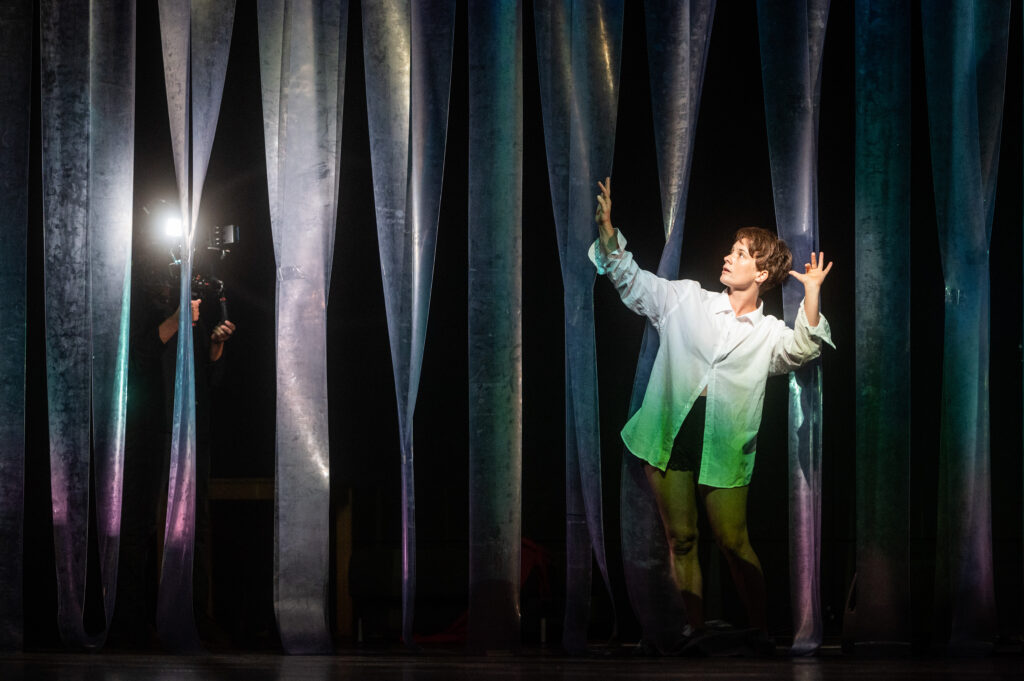
In a letter to Berberian, Berio insisted that the text of Recital I (for Cathy) should not be printed. ‘The listener must be under the impression that you are improvising the text on the spot. (…) After all, the audience must keep their eyes on you at all times and not be distracted by the program, trying to see where you are.’
He regarded Recital as a collection of heterogeneous elements, which he treated as autonomous entities. ‘Most of them are not organically connected, but simply placed side by side.’ Only one part of the piece is a fully developed concert work and is performed as such: Avendo gran disio for voice and piano, set to a text by Jacopo da Lentini, which Berio composed in 1948.
Recital I (for Cathy) is emblematic of the musical collage style that Berio and many of his contemporaries embraced in the 1970s. The best-known example is Sinfonia (1969), written for eight amplified voices and large orchestra, a work in which music, politics, literature, and cultural history are intricately interwoven.
Yet the 35-minute Recital I (for Cathy) also carries a more intimate resonance. After fourteen years of marriage, Berio began a relationship with another woman, and in 1964 he sought a divorce from Berberian. This caused her to spiral into a deep personal crisis, as revealed in letters she wrote to her pianist and confidant Louis Andriessen—who later paid tribute to her in Letter from Cathy (2003), a setting of one such letter.
That the singer in Recital I (for Cathy) is abandoned by her (onstage) partner, gradually becomes more confused, and ultimately loses her grip on reality, can hardly be seen as separate from the painful rupture with Berio—though their professional collaboration did, remarkably, endure.